

TL;DR:
- Reading glasses and distance glasses are designed for distinct focal ranges and should not be interchanged.
- Using the wrong type of glasses can cause eye strain, discomfort, and blurry vision.
- Choosing the right eyewear depends on your daily tasks and lifestyle, with options like single vision, bifocals, or multifocals.
Many Australians reach for their reading glasses to check the highway signs, or squint through their distance glasses trying to read a restaurant menu, then wonder why everything looks wrong. The truth is that reading glasses and distance glasses are engineered for completely different focal ranges, and mixing them up doesn’t just cause blurry vision — it causes real discomfort. Understanding why your eyes need different support at different distances is the first step toward choosing eyewear that actually works for your life. This article breaks down the core differences, the choices available to you, and the mistakes worth avoiding.
Table of Contents
- How the eyes work: near vs distance vision
- What makes reading glasses different from distance glasses?
- How to choose: single vision, multifocals, or two pairs?
- Common pitfalls and real-world tips for Aussie glasses wearers
- What most people in Australia miss about glasses choices
- Find the right lenses and keep them working for you
- Frequently asked questions
Key Takeaways
| Point | Details |
|---|---|
| Glasses serve different distances | Reading glasses help with close tasks, distance glasses clarify far-away vision. |
| Wrong use causes eye strain | Wearing reading glasses for distance or vice versa can lead to blur and tired eyes. |
| Lens choice matches your lifestyle | Choose between single vision, multifocal, or separate pairs based on your daily activities. |
| Check your prescriptions carefully | Australian prescriptions separate near and distance corrections—understand them for the best fit. |
How the eyes work: near vs distance vision
Let’s start by looking at how your eyes focus up close and far away.
Your eye contains a natural lens that changes shape depending on what you’re looking at. When you glance at something nearby, tiny muscles squeeze the lens into a rounder, more curved shape to bring that object into focus. When you look at something far away, those same muscles relax and the lens flattens out. This process is called accommodation, and in healthy younger eyes, it happens automatically and effortlessly.
The problem is that accommodation fades with age. Starting around your early to mid-forties, the lens inside the eye gradually stiffens and loses its ability to shift shape as easily. This condition is called presbyopia, and it’s the reason so many Australians suddenly find small print frustratingly blurry after years of perfectly fine vision. Presbyopia is not a disease. It’s a completely normal part of ageing, and corrective lenses are the most common solution.
This is where the distinction between reading glasses and distance glasses becomes critical:
- Reading glasses (sometimes labelled SVN, or single vision near) are designed to support close-up vision, typically for tasks within arm’s reach
- Distance glasses (labelled SVD, or single vision distance) are designed to sharpen objects that are far away, like road signs, TV screens, or faces across the room
- Some prescriptions combine both needs through multifocal lenses, but these are a separate category entirely
As a general rule, lens type is chosen based on the distances you need to see clearly. This sounds obvious, but it’s frequently overlooked when people self-select glasses without an up-to-date prescription.
Your optometrist isn’t just measuring how blurry your vision is — they’re determining the precise distance range where your eyes struggle most, and matching a lens to that range.
If you’ve been wondering whether your reading glasses could help with improving reading vision more comfortably, the answer often lies in understanding exactly what SVN lenses are built to do.
What makes reading glasses different from distance glasses?
Now that you know why your eyes need different support for different distances, let’s break down exactly how reading glasses and distance glasses are crafted for those needs.
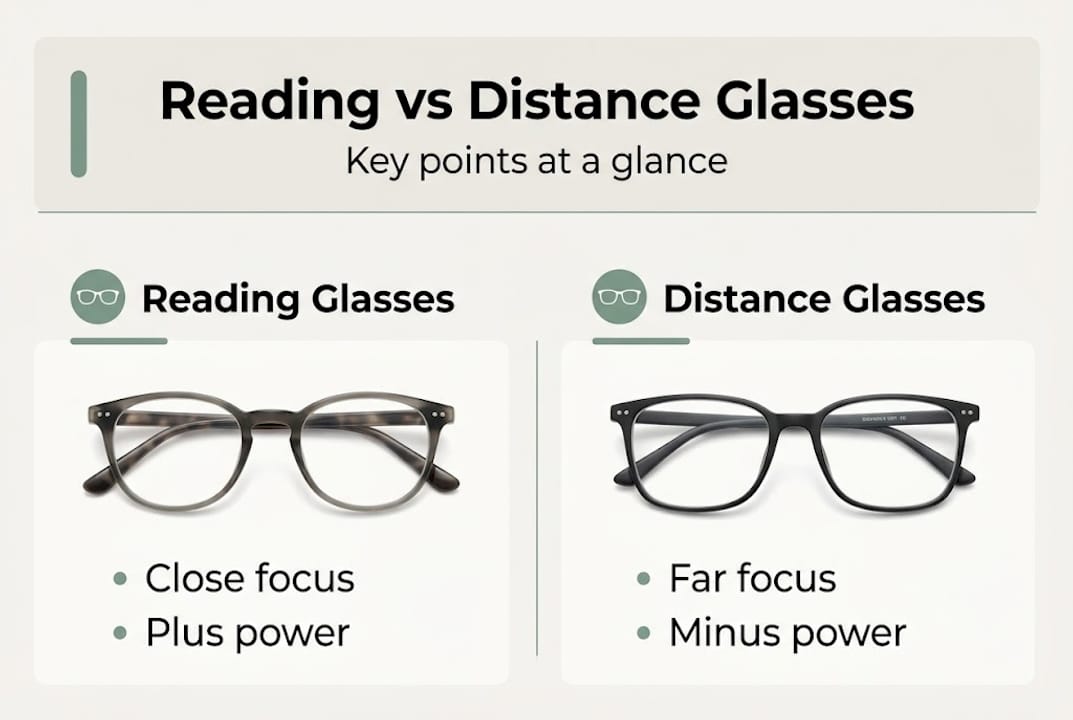
Reading glasses have a positive lens power (expressed as a plus number like +1.50 or +2.50). This positive power magnifies and brings close objects into sharp focus, making text on a page or a phone screen much clearer. The higher the number, the stronger the magnification.

Distance glasses, on the other hand, typically carry a negative lens power (like -1.25 or -3.00), which corrects short-sightedness (myopia) by redirecting light so that distant objects become clear. Some distance prescriptions are also positive, used to correct long-sightedness (hyperopia), but the focal point is still set for far distances rather than close work.
The real issue comes when people swap them around. Using the wrong type of glasses can cause blur and eye strain because the lens forces the eyes into an inappropriate focal range. Your eyes work overtime trying to compensate, which leads to headaches, fatigue, and sore eyes by the end of the day.
| Feature | Reading glasses | Distance glasses |
|---|---|---|
| Lens power | Positive (+) | Negative (or specific +) |
| Best for | Books, phones, close tasks | Driving, TV, recognising faces |
| Effect if used wrong | Distance becomes blurry | Close objects are hard to focus |
| Common prescription label | SVN | SVD |
For people who spend significant time at a screen, there’s also a middle ground. Tasks like reading and computer work sit at an intermediate distance, roughly 50 to 70 centimetres away, which is neither near nor far. Standard reading glasses often aren’t set at quite the right power for this distance, which is why occupational or computer lenses exist as a distinct option.
Pro Tip: If you find your reading glasses feel slightly off when using a laptop, the problem might not be the glasses — it could be that your screen sits just outside the focal sweet spot for your current lens power.
Understanding why reading glasses matter in day-to-day tasks helps put these differences into perspective.
How to choose: single vision, multifocals, or two pairs?
Understanding the technical differences leads directly to making the right choice for your own everyday habits.
There is no universal answer. Your ideal solution depends almost entirely on what your day actually looks like. Consider the following:
- Do you mostly do one type of task? If you spend most of your time reading or at a desk, a dedicated pair of reading glasses makes sense. If you drive regularly but rarely read printed text, single vision distance glasses may be all you need.
- Do you switch between near and distance tasks often? Someone who works at a computer in the morning, drives in the afternoon, and reads at night may find constantly swapping glasses tedious. That’s where multifocals become appealing.
- Are you new to prescription glasses? Starting with two separate pairs can be easier than adjusting to progressives, which have a learning curve that some people find frustrating at first.
Presbyopia correction is often done with reading-only or multifocal designs that include a near addition (called ADD) in the lens. The ADD value on your prescription tells the optometrist how much extra power to add for close-up focus on top of your distance correction.
| Solution | Best for | Trade-off |
|---|---|---|
| Single vision reading | Dedicated close work | Can’t see distance clearly |
| Single vision distance | Driving, sport, daily distance | Can’t read up close |
| Bifocals | Near and distance in one | Visible line, takes adjustment |
| Progressive lenses | Seamless near to distance | Narrower fields, learning curve |
| Two separate pairs | Task-specific clarity | Inconvenient to swap |
Exploring the range of types of reading glasses lenses can help you narrow down what matches your lifestyle. And once you’ve chosen your lenses, following reading glasses safety tips keeps them working well for longer.
Pro Tip: Ask your optometrist to note your working distance (the distance from your eyes to your screen or book) on your prescription. This makes choosing the right ADD power much easier when you’re shopping for lenses.
Common pitfalls and real-world tips for Aussie glasses wearers
By now you understand your options — here are some mistakes to avoid and best practices from real-life Aussie experiences.
One of the most dangerous mistakes is wearing reading glasses while driving. Reading glasses make far objects blurry because they magnify for close focus rather than supporting distance clarity. This isn’t just uncomfortable — it’s genuinely unsafe on the road. Always keep your distance glasses (or prescription sunglasses) in the car and never substitute reading glasses behind the wheel.
Here are some common pitfalls and how to avoid them:
- Skipping the eye test: Over-the-counter reading glasses use standard powers and don’t account for differences between your left and right eyes. A proper prescription catches these asymmetries.
- Wearing glasses that are too strong: Many people assume stronger is better. Using higher magnification than you need strains your eyes and actually makes vision worse for that task.
- Ignoring fit: Glasses that sit too low on your nose or slip constantly cause eye strain as you strain to look through the wrong part of the lens.
- Forgetting your working distance: If you often read with your book quite close, you may need a different power than someone who holds their book at arm’s length.
Knowing how to pick the right lens power removes much of the guesswork from buying reading glasses. There’s also solid advice available on choosing glasses for work that covers how your environment affects which lenses suit you best.
Pro Tip: Keep a small glasses cleaning cloth with your reading glasses. Smudged lenses are a surprisingly common cause of eye strain that people often blame on their prescription.
For a full rundown of dos and don’ts, check out the guide to reading glasses dos and don’ts to build good habits from the start.
What most people in Australia miss about glasses choices
Here’s something we’ve noticed that rarely gets mentioned in standard optometry advice: most Australians choose their lenses based entirely on their diagnosis, not their lifestyle.
Your optometrist tells you that you need reading glasses, and you nod and buy a pair. That’s the right start. But very few people then ask themselves: how many hours a day do I actually spend reading versus driving versus staring at a screen? That question changes everything.
Someone who works in a trade and spends most of their day outdoors has very different needs from someone who edits documents at a desk for eight hours. Yet both might walk out with identical reading glasses because their prescriptions look similar on paper.
A lifestyle audit before you buy — even just jotting down your main daily visual tasks — takes five minutes and can save you months of discomfort. Our everyday vision tips are a good starting point for matching lens choices to real-life habits. The best pair of glasses isn’t the most expensive one. It’s the one that fits how you actually live.
Find the right lenses and keep them working for you
Now that you know what separates reading glasses from distance glasses, the next step is finding options that match your vision needs and your lifestyle.
At Ministry of Sight, we stock a wide range of eyewear solutions designed for everyday Australians. Whether you’re after a stylish pair for close-up tasks or practical accessories to protect and maintain your glasses, we’ve got you covered. Browse our full range of reading glasses accessories to keep your eyewear in top shape, or treat yourself to a set of elegant eyewear chains so your glasses are always within reach. With free shipping across Australia and a satisfaction guarantee, making the right eyewear decision has never been easier.
Frequently asked questions
Can I use reading glasses for distance vision?
No, reading glasses are designed only for close-up tasks. Using the wrong glasses causes blur and eye strain because the lens is not matched to that focal range.
What happens if I use distance glasses for reading?
Distance glasses are not designed for close work, so they make it difficult to focus on nearby text or objects. Lens type is chosen based on the specific distances where your vision needs support.
Should I get one pair of multifocal glasses or two separate pairs?
It depends on your daily activities. Presbyopia correction is often done with multifocal designs that cover several distances, but two dedicated pairs can be simpler if your tasks are clearly separated.
Can incorrect glasses damage my eyes?
Wearing the wrong prescription or lens type causes discomfort, blurry vision, and eye fatigue, but it does not cause permanent damage to your eyes. The sooner you switch to the correct lenses, the sooner the discomfort resolves.
Recommended
- Reading Glasses Explained: Key Benefits and Necessity – MINISTRY OF SIGHT
- Reading glasses safety tips for clear, comfortable vision – MINISTRY OF SIGHT
- How Reading Glasses Improve Reading: Complete Guide – MINISTRY OF SIGHT
- Understanding What are Reading Glasses and Their Importance – MINISTRY OF SIGHT


