

Choosing the perfect pair of reading glasses can feel overwhelming when balancing fashion, budget, and everyday practicality. For stylish Australians who want vision clarity without breaking the bank, it matters that eyewear is more than just functional—it should look sharp and work seamlessly for close-ups on screens or print. Discover how modern readers combine sleek designs, effective magnification, and essential safety standards to become a standout accessory for both your wardrobe and your wallet.
Table of Contents
- See Readers Defined: Function And Key Uses
- Types Of Readers And Lens Options Explained
- How To Choose The Right Reader Strength
- Fashion, Materials, And Accessory Trends
- Buying Online: Australian Tips And Pitfalls
Key Takeaways
| Point | Details |
|---|---|
| Understanding Readers | Reading glasses are designed to assist those with presbyopia, improving clarity for near-vision tasks with convex lenses. |
| Types of Readers | Options include full-frame, half-frame, bifocal, and progressive no-line readers to suit varying needs and preferences. |
| Choosing Magnification | Selecting the right magnification strength is crucial; typically, adults begin needing readers between ages 40-45. |
| Online Purchasing Tips | When buying readers online, ensure to verify prescriptions, measurements, and return policies to safeguard your vision and rights. |
See Readers Defined: Function And Key Uses
Reading glasses, also known as readers, are specialised visual aids designed to address age-related vision challenges. These non-prescription spectacles serve a critical purpose for adults experiencing presbyopia, a natural condition where the eye’s ability to focus on close objects diminishes with age.
Readers work through a simple yet ingenious mechanism: convex lenses that provide targeted magnification. When you hold reading material at a standard distance (typically 35-40 centimetres), these lenses help adjust your focal point, making text and close-up details appear crisp and clear. Unlike prescription glasses, readers offer a universal solution for near-vision tasks such as:
- Reading books and newspapers
- Working on computer screens
- Threading needles
- Detailed craftwork
- Checking smartphone messages
Medically classified as visual assistance devices, readers are regulated by health authorities like the FDA. They must meet specific safety standards including impact resistance and optical quality. This ensures that while they’re readily available over-the-counter, they still maintain important performance and safety benchmarks.
Pro tip: When selecting readers, always test multiple magnification strengths to find the most comfortable option for your specific vision needs.
Types Of Readers And Lens Options Explained
Reading glasses come in a diverse range of designs, each tailored to address specific vision needs and lifestyle preferences. The primary categories are distinguished by their lens configuration, frame style, and unique functional features that enhance visual comfort and performance.
Most readers fall into several key classifications. Full-frame readers provide complete lens coverage, offering comprehensive magnification across the entire lens surface. In contrast, half-frame readers feature a minimalist design with lenses supported only at the top, providing a lighter and more streamlined aesthetic. Another innovative option is bifocal readers, which integrate two distinct magnification zones: a lower section for close-up tasks and an upper section for distance vision.
Modern reader designs have expanded to include specialised variants like blue-light blocking lenses, which reduce digital screen strain, and progressive no-line bifocals that offer seamless focal transitions without visible demarcation lines. Magnification strengths typically range from +1.00 to +3.50 dioptres, allowing users to select precisely matched vision correction.

Here’s a concise comparison of common reader types to help you select the most suitable option:
| Reader Type | Lens Coverage | Best For | Design Feature |
|---|---|---|---|
| Full-frame | Entire lens | Extended reading | Complete magnification |
| Half-frame | Top section only | On-off rapid tasks | Lightweight, minimalist |
| Bifocal | Split lens zones | Mixed near and distance | Upper and lower sections |
| Progressive no-line | Seamless transitions | Multiple vision ranges | No visible lens lines |
Frame materials and styles also play a significant role in reader selection. Options range from lightweight plastic and metal frames to more sophisticated designs incorporating flexible hinges, anti-reflective coatings, and ergonomic nose supports. Some contemporary readers even integrate fashion-forward elements, transforming functional eyewear into stylish accessories.
Pro tip: Always test readers in natural reading positions to ensure optimal comfort and clarity before making a final selection.
How To Choose The Right Reader Strength
Selecting the appropriate reader strength is a nuanced process that requires careful consideration of your individual vision needs and daily visual tasks. Magnification strength, measured in dioptres, plays a crucial role in determining the right pair of reading glasses for optimal visual comfort and performance.
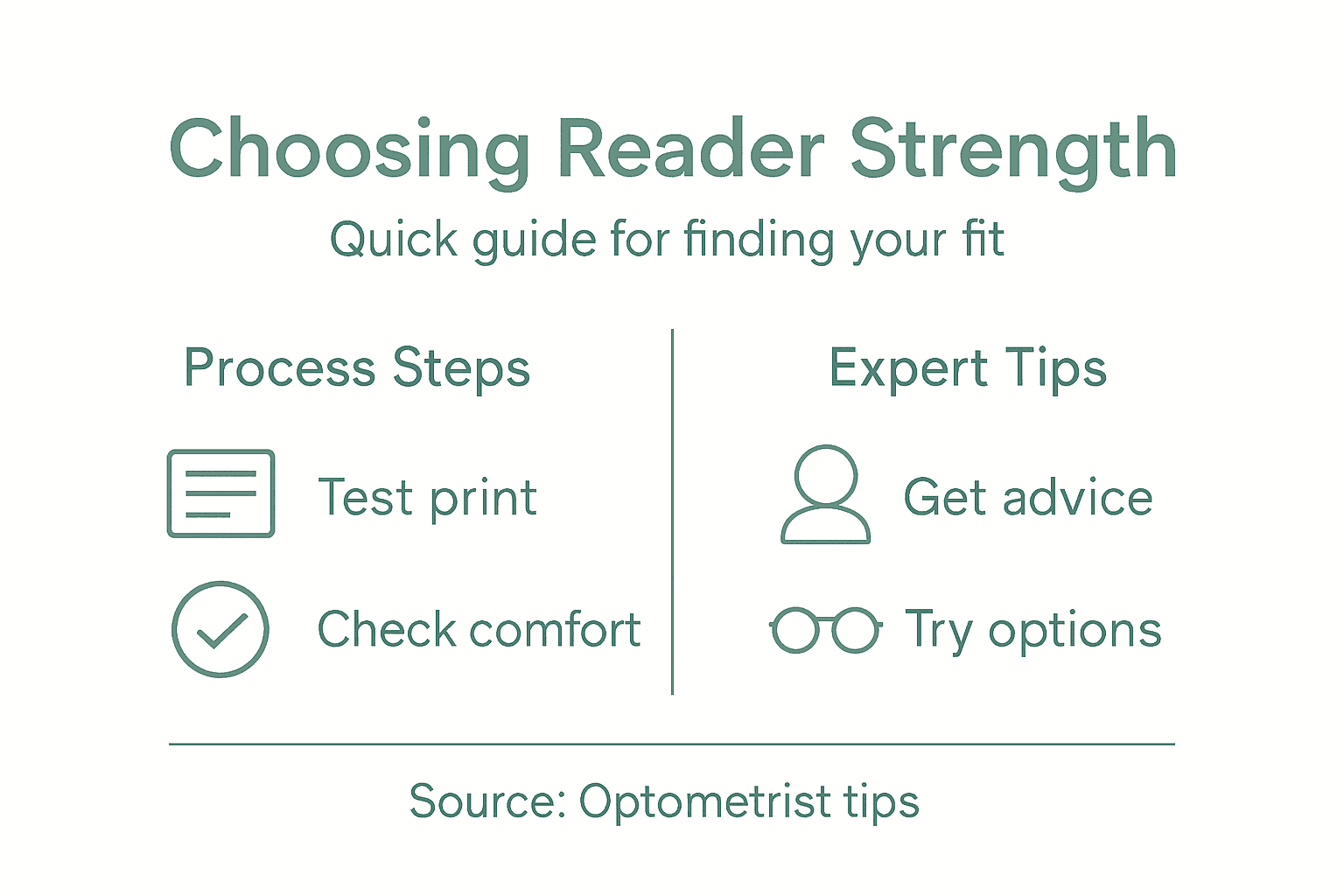
To identify the correct lens power, start by understanding your vision challenges. Most adults begin needing reading glasses between ages 40-45 as presbyopia develops. The typical magnification range starts at +1.00 and increases in increments to +3.50, with each step offering progressively stronger visual assistance.
Practical assessment methods include:
- Conducting a simple reading test at your standard reading distance (35-40 centimetres)
- Using a reading chart to evaluate text clarity
- Trying on multiple strengths to determine comfortable focus
- Checking how clearly you can read small print without straining
While over-the-counter readers provide convenience, consulting an optometrist offers the most precise strength recommendation. They can assess not just magnification needs, but also potential astigmatism or uneven vision requirements that might necessitate custom solutions.
Pro tip: When testing reader strengths, choose print that represents your typical reading material and assess comfort over multiple minutes, not just seconds.
Fashion, Materials, And Accessory Trends
Reading glasses have transcended their purely functional origins, emerging as sophisticated fashion statements that reflect personal style and technological innovation. Contemporary eyewear design seamlessly blends aesthetic appeal with cutting-edge materials and performance features.
Frame shapes are experiencing a dynamic evolution, with trending styles ranging from minimalist oval frames to bold oversized squares. Current design preferences emphasise clean lines, soft cat-eye silhouettes, and vintage-inspired contours that complement diverse facial structures. Material innovations have equally transformed reader design, introducing lightweight options like titanium and sustainable acetate that prioritise both comfort and environmental consciousness.
Material selections now go beyond traditional expectations. Sustainable materials are gaining significant momentum, with recycled acetate and bio-based resins becoming increasingly prevalent. Advanced lens technologies complement these material innovations, offering features like blue light protection, enhanced clarity, and integrated smart technologies that transform reading glasses from simple vision aids into sophisticated personal accessories.
Use this quick reference to understand how frame material choices affect comfort and durability:
| Material | Comfort Level | Durability | Eco Consideration |
|---|---|---|---|
| Plastic | Lightweight | Moderate | Widely recyclable |
| Metal | Varies by alloy | Highly resilient | Often contains recycled content |
| Titanium | Ultra-lightweight | Very strong | Hypoallergenic, long-lasting |
| Acetate | Flexible fit | Good durability | Available in bio-based form |
Accessory trends are expanding the reading glasses ecosystem, with complementary items like elegant chains, interchangeable temples, and protective cases becoming statement pieces in their own right. The contemporary reader is no longer just a vision correction tool, but a personalised expression of individual style and technological sophistication.
Pro tip: When selecting reading glasses, prioritise frames that not only suit your vision needs but also reflect your personal aesthetic and lifestyle preferences.
Buying Online: Australian Tips And Pitfalls
Purchasing reading glasses online offers convenience and variety, but Australian consumers must navigate the digital marketplace with strategic awareness. Understanding the nuances of online eyewear shopping can help you secure quality products while protecting your consumer rights and vision health.
Online glasses purchasing strategies require careful consideration of several critical factors. Australian consumer protection laws mandate that online sellers, both domestic and international, must comply with mandatory safety standards. This means verifying the retailer’s credentials, checking product compliance, and understanding your rights before completing a purchase.
Key considerations for safe online reader purchases include:
- Confirming current and accurate prescription details
- Verifying all necessary measurements (sphere, cylinder, axis, pupillary distance)
- Checking frame dimensions against your facial measurements
- Understanding return and exchange policies
- Reviewing product safety certifications
Technological advancements have simplified online glasses shopping, with many websites offering virtual try-on features and detailed sizing guides. However, consumers should remain vigilant about potential pitfalls such as inaccurate measurements, limited return windows, and potential discrepancies between online representations and actual products.
Pro tip: Always request a detailed prescription copy with complete measurements before initiating an online glasses purchase to ensure maximum accuracy and fit.
Discover Why Stylish Reading Glasses Are Essential for You
Reading glasses are no longer just functional tools to ease presbyopia they have become key style statements that align with your vision needs and personal aesthetic. The challenge many face is finding the right balance between comfort, magnification strength and fashionable design. At Ministry of Sight we understand how important it is to wear readers that make you feel confident while delivering clear focus on everyday tasks.
Explore our exclusive collection of Stylish Reading Glasses for Men and Women crafted to suit diverse tastes and vision requirements. Whether you prefer classic shapes or desire the latest trends like Square Reading Glasses we offer selections that combine durability, comfort and eye health features. Don’t compromise on your sight or style visit Ministry of Sight now to enjoy our free shipping across Australia plus special offers that make updating your eyewear simple and rewarding.
Frequently Asked Questions
What are reading glasses and how do they work?
Reading glasses, also known as readers, are non-prescription spectacles designed to address presbyopia, a common age-related vision issue. They use convex lenses to provide magnification, making close-up text and details easier to see by adjusting your focal point.
What types of reading glasses are available?
There are several types of reading glasses, including full-frame readers (which offer complete lens coverage), half-frame readers (with only the top section for a minimalist design), bifocal readers (with two distinct magnification zones), and progressive no-line readers (which provide seamless focal transitions).
How do I choose the right strength for reading glasses?
To choose the correct strength, start by identifying your vision challenges. Most adults begin needing reading glasses between 40-45 years of age. Strengths typically range from +1.00 to +3.50 dioptres. Conducting a simple test at your regular reading distance can help determine the most comfortable magnification level.
What materials are reading glasses frames made of?
Reading glasses frames can be made from various materials including plastic, metal, titanium, and acetate. Each material offers different comfort levels, durability, and eco-friendliness, contributing to an individual’s overall experience with the readers.
Recommended
- Stylish Glasses Explained: Benefits, Types, Choices – ministry of sight
- Understanding Fashionable Reading Glasses Guide for Style – ministry of sight
- Nerdy Glasses Are the Coolest Look – ministry of sight
- Role of Fashion in Eyewear: Complete Guide – ministry of sight
- Complete Guide to Starting a Style Blog - DressMeUpNY


