

TL;DR:
- Buying glasses lenses online in Australia can lead to hidden costs and rebate issues if you are unprepared.
- Preparation includes verifying a recent prescription, accurate PD measurement, and a claimable invoice for rebates.
Buying glasses lenses online in Australia sounds like an easy way to cut costs, until you get hit with an unexpected out-of-pocket bill because your health fund won’t accept the invoice, or your new lenses arrive and the vision just feels off. These frustrations are more common than you’d think, and they usually come down to three things: hidden costs, rebate confusion, and getting the fit wrong. This guide walks you through exactly what to prepare, how to choose the right seller, and how to make sure you’re genuinely saving money rather than just thinking you are.
Table of Contents
- What you need before buying glasses lenses online
- Step-by-step guide to buying glasses lenses online
- Common mistakes and how to avoid them
- Getting the best value: Offers, rebates and no-gap options
- Our take: Why rebate-friendly providers matter more than price
- Next steps: Shop glasses lenses and accessories with confidence
- Frequently asked questions
Key Takeaways
| Point | Details |
|---|---|
| Check rebate eligibility | Only buy from providers with proper invoice for rebates, or you’ll pay more out of pocket. |
| Verify your PD | Accurate pupil distance is crucial for comfortable, effective vision when buying online. |
| Stack offers | Look for deals you can combine with health fund rebates for maximum savings. |
| Avoid common pitfalls | Mistakes like wrong PD or hidden costs are easy to avoid if you follow this guide. |
| Choose reputable sellers | Trustpilot reviews and rebate policies are key to picking the right provider. |
What you need before buying glasses lenses online
Now that you know what to expect, let’s look at what you’ll need before clicking ‘buy’. Getting organised before you shop is the single biggest thing you can do to avoid regret. Skipping this step is how people end up with lenses that don’t fit, invoices their health fund won’t touch, or promotions they can’t actually use.
Here’s what to gather before you start:
- Your current prescription: Make sure it’s no more than two years old. Prescriptions for progressive or multifocal lenses can be especially complex, so double-check the sphere, cylinder, and axis values are clearly readable.
- Your PD (pupillary distance) measurement: This is the distance in millimetres between the centre of your pupils. Your optometrist can provide this, or you can request it specifically. Many optometrists don’t include it on standard printouts unless you ask.
- Your health fund details: Log into your health fund portal and check your optical benefit balance, your claiming period reset date, and whether the fund requires a specific receipt format.
- Promotional terms: Some deals exclude certain lens types, or only apply to frames rather than lenses. Read the fine print before you add anything to your cart.
For a broader walkthrough of the process, check out this step-by-step online glasses buying guide that covers the full purchase journey.
Pro Tip: Ask your optometrist to write your PD directly on your prescription, and photograph it before you leave the clinic. It takes 30 seconds and saves a lot of hassle later.
One of the most important things to check is rebate eligibility. Health fund rebates vary considerably, with some online retailers providing fully claimable invoices while others offer little to no rebate support, leading to higher out-of-pocket costs. Optical chains like Specsavers and OPSM often offer low or no-gap options under health fund arrangements, while some pure online discounters have been criticised in reviews for failing to provide compliant invoices.
| Factor | What to check | Why it matters |
|---|---|---|
| Prescription freshness | Within 2 years | Ensures legal and accurate lens making |
| PD measurement | Millimetres, monocular if possible | Affects how lenses centre on your eyes |
| Health fund balance | Optical benefit remaining | Determines how much you can claim |
| Invoice format | Tax invoice with optical item codes | Required by most health funds |
| Promotion eligibility | Applies to lenses, not just frames | Avoids disappointment at checkout |
For more practical advice on selecting the right seller and avoiding common traps, the tips for buying glasses online resource covers several scenarios Australian buyers regularly face.
Step-by-step guide to buying glasses lenses online
With your information ready, here’s how to purchase lenses step by step.
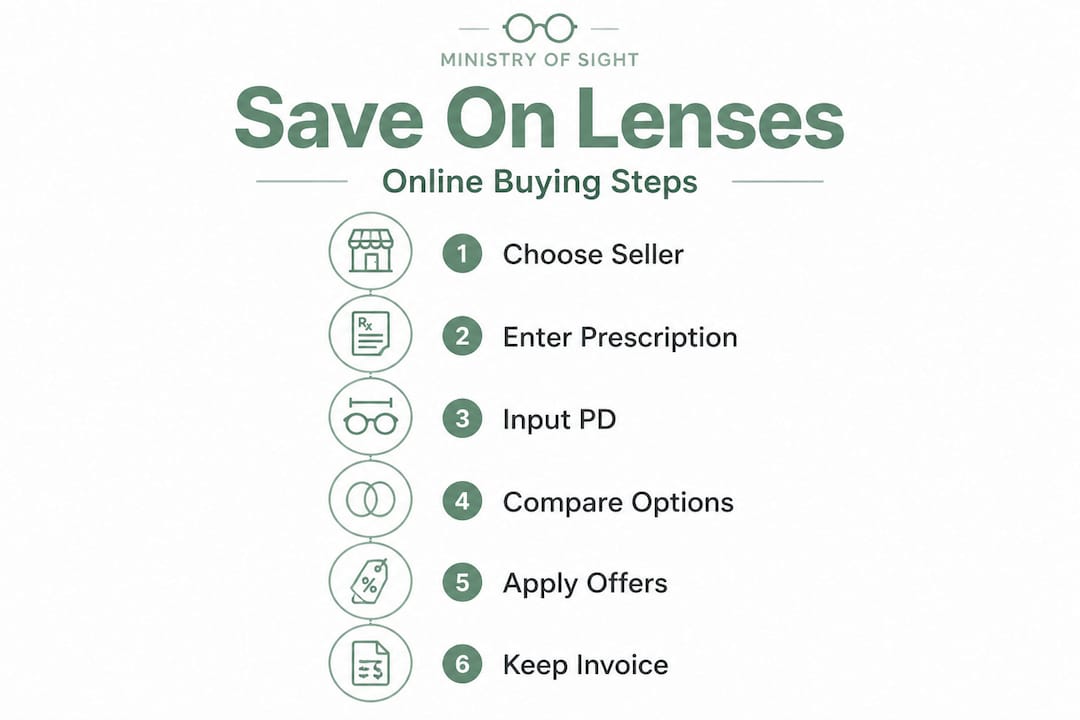
1. Choose a seller that provides claimable receipts Start by confirming whether the retailer issues a proper tax invoice with optical item codes. This is non-negotiable if you want to claim a rebate. Check their FAQ or contact customer service before you spend time configuring your order.
2. Enter your prescription details carefully Use your written prescription and enter each value one field at a time. Don’t rely on memory. Left and right eyes have separate values, and mixing them up is a surprisingly common mistake that results in lenses that need to be remade.
3. Input your PD accurately Verifying your PD for online orders is critical because even a 1 to 2 mm error can cause eyestrain, headaches, and distorted peripheral vision. If you have a monocular PD (separate measurements for each eye), use those values rather than a single combined number.
4. Compare lens types and optional coatings Standard single vision lenses are the most affordable, but you may benefit from anti-reflective coating, photochromic (light-reactive) lenses, or blue light filtering, especially if you spend long hours at a screen. Weigh up the cost against how much you use your glasses each day.
5. Apply promotions and check rebate compatibility Stackable promotions at optical chains like Specsavers and OPSM allow you to combine deals with your health fund benefit, minimising what you pay out of pocket. Pure online discounters may offer a lower sticker price but without the rebate compatibility, the final cost can actually be higher.
6. Place your order and save your documentation Keep your order confirmation email, the tax invoice, and your prescription copy in one folder (digital or physical). Some health funds require you to submit within a set period, so don’t leave the paperwork in your inbox and forget about it.
| Seller type | Typical price | Claimable invoice | Rebate compatibility | Promotions |
|---|---|---|---|---|
| Optical chain (in-store/online) | Moderate to high | Yes | Strong | Often stackable |
| Reputable online specialist | Low to moderate | Usually yes | Varies | Sometimes stackable |
| Pure online discounter | Low | Often no | Weak or none | Usually not |
If delivery speed matters to you, it’s worth reviewing fast delivery prescription glasses options in Australia before committing to a particular retailer. For those shopping specifically for reading lenses, this reading glasses buying guide covers what to look for in lower-powered lenses.
Pro Tip: Screenshot the promotion terms at the time of purchase. Retailers sometimes update their promotional pages mid-campaign, and having the original terms documented protects you if there’s a dispute.
Common mistakes and how to avoid them
Even with good preparation, there are pitfalls to avoid when buying lenses online. Knowing what goes wrong for other shoppers means you can sidestep the same problems without learning the hard way.

Getting the PD wrong This is by far the most common issue. A PD that’s even slightly off means your eyes aren’t looking through the optical centre of the lens, which causes fatigue and blurry vision. Always measure twice or get your optometrist to confirm the number in writing.
Ordering from a seller that doesn’t issue claimable invoices Some online retailers receive criticism for low or no rebate support, leaving customers with higher out-of-pocket costs than anticipated. Before you buy, explicitly ask: “Will your invoice be accepted by Australian health funds?” If they can’t answer clearly, shop elsewhere.
Ignoring hidden postage and extras A lens price that looks cheap can climb quickly once you add anti-reflective coating, express shipping, or a hard case. Always build to the full spec you actually want before comparing prices between sites.
Not checking return and remake policies If your lenses arrive and the vision feels off, what happens next? Some online sellers offer free remakes within a set period; others don’t. Reading the return policy before you buy is much easier than arguing about it afterwards.
“Chasing a low headline price without checking invoice compliance and return policies is one of the most expensive things you can do with your eyes.”
If you’re shopping for reading glasses in particular, this guide on choosing reading glasses online covers magnification strength, frame fit, and what to look for in lens quality. And if style matters to you as much as function, take a look at how to buy stylish glasses online without compromising on optical quality.
Getting the best value: Offers, rebates and no-gap options
Finally, let’s see how to stretch your dollar and make the most of rebates and offers.
The gap between what you pay for glasses and what your health fund covers can be significant. The good news is that with a bit of planning, you can reduce or even eliminate that gap entirely.
Who actually provides claimable invoices? Only some online sellers issue invoices in the format health funds require. Before shopping, look for retailers that clearly advertise their receipts as compliant with Australian health fund requirements. If it’s not mentioned anywhere on the site, that’s a red flag worth following up on.
Stacking promotions with your health fund Optical chains often allow promotions to stack with health fund benefits, which is where the real savings happen. A buy-one-get-one deal combined with an optical benefit claim can bring your total outlay down dramatically compared to buying at full price, even at a “cheap” online store.
Here’s a realistic comparison:
| Scenario | Lens cost | Health fund rebate | Out-of-pocket |
|---|---|---|---|
| Online discounter, no invoice | $80 | $0 (not claimable) | $80 |
| Online specialist with invoice | $120 | $80 | $40 |
| Chain with no-gap deal + fund | $160 | $160 | $0 |
Optical chains like Specsavers and OPSM frequently offer low or no-gap arrangements for health fund members, meaning you pay nothing beyond your premium. This isn’t always advertised loudly, so it’s worth calling ahead and asking specifically about no-gap lens options for your fund.
Key things to check when comparing providers:
- Does the retailer clearly state their invoice is health fund compliant?
- Is there a BOGO (buy one, get one) or similar promotion running right now?
- Can you stack that promotion with your optical benefit?
- What is their Trustpilot or Google rating for customer service and rebate handling?
- Do they have a clear return or remake policy if the fit is wrong?
For a broader look at lens options, comparing reading glasses versus distance glasses can help you choose the right lens type before you start pricing. And if you’re ready to shop, the reading glasses online Australia guide covers reputable options in more detail.
Our take: Why rebate-friendly providers matter more than price
With the practical steps covered, here’s our experience-based perspective to help you choose wisely.
The lowest price in any product category is almost never the best value. With glasses lenses, this is especially true. We’ve seen customers come to us after buying from a heavily discounted online site, only to find the lenses were made slightly off their PD, the seller won’t provide a remake, and the invoice doesn’t meet their health fund’s requirements. They’ve paid less upfront and ended up spending more overall, including the cost of getting new lenses made properly.
The uncomfortable truth is that rebate eligibility and invoice clarity are worth more than a $20 or $30 price difference. If your health fund optical benefit is worth $150 to $200 and you forfeit it by buying from a non-compliant retailer, you haven’t saved anything. You’ve lost money while thinking you were being savvy.
What we’d encourage you to do is prioritise three things above price. First, confirm the invoice policy before you order. Second, check the seller’s reputation specifically for rebate and return handling, not just general star ratings. Third, make sure you understand the remake or refund process in writing before you pay.
A seller who charges a little more but provides a fully claimable invoice, clear return terms, and responsive customer support is almost always the better choice. Visit our guide on how to shop reading glasses online for a breakdown of what separates reputable sellers from the rest.
The eyewear market in Australia has genuinely good options at competitive prices. You don’t need to accept poor service or confusing rebate situations. You just need to know what to look for before you buy.
Next steps: Shop glasses lenses and accessories with confidence
If you’re ready to upgrade your lenses with confidence, here’s where to start shopping and get expert help.
At Ministry of Sight, we’ve built our range around making the experience straightforward for Australians who want quality eyewear at fair prices, with the transparency around invoicing and rebates that online shoppers deserve. Whether you’re after prescription lenses or fashion frames, our catalogue is designed to take the guesswork out of buying online.
Browse our glasses accessories and storage collection to find everything you need to protect and maintain your lenses. For something a bit different, the lens lounge is worth exploring as a stylish and practical option. And if you’d like to know more about who we are and what we stand for, visit the about Ministry of Sight page. We offer free shipping across Australia, satisfaction guarantees, and the kind of product support that makes buying online feel genuinely low-risk.
Frequently asked questions
Can I claim health fund rebates for online glasses lenses?
You can claim rebates if the online retailer provides a proper tax invoice in the required format; many pure discounters do not issue compliant invoices, which means your claim will be rejected.
What is PD and why does it matter for buying lenses online?
PD (pupillary distance) is the measurement in millimetres between the centres of your pupils, and an incorrect PD can result in eyestrain, headaches, or distorted vision because the optical centre of the lens won’t align with your eyes.
Are online-only lens retailers riskier than chains for rebates?
Online-only retailers often don’t offer fully claimable invoices or flexible rebate terms, while optical chains like Specsavers and OPSM regularly offer low or no-gap arrangements for health fund members.
Do promotional offers stack with health fund rebates?
Yes, at many optical chains promotions can stack with your health fund optical benefit, which can significantly reduce or completely eliminate your out-of-pocket cost.


