

Most people assume their new glasses will hold up just fine to daily life. Then, a few months in, those tiny surface scratches start appearing, and suddenly everything looks slightly blurred or hazy. It is a frustrating and surprisingly common experience. Scratch-resistant lenses are designed to change that outcome, but there is a lot of confusion about what they actually do, how long they last, and whether they are worth the investment. If you live an active Australian lifestyle, spend time outdoors, or simply want your glasses to go the distance, understanding these lenses properly makes a real difference.
Table of Contents
- Why scratch-resistant lenses matter: Everyday realities
- Core benefits: How scratch-resistant lenses improve your glasses
- What makes scratch-resistant coatings work?
- Limitations and care: Setting realistic expectations
- What most Australians miss about scratch-resistant lenses
- Ready to upgrade? Explore eyewear and accessories
- Frequently asked questions
Key Takeaways
| Point | Details |
|---|---|
| Longer lens life | Scratch-resistant lenses can double or triple the lifespan of your eyewear with proper care. |
| Clearer vision longer | Lenses maintain visual clarity by preventing scratch build-up from daily wear and tear. |
| Save money | You spend less on replacements over time, making scratch-resistant options cost-effective. |
| Best for active lives | Australians with busy, outdoor lives benefit most from scratch-resistant features. |
| Care still matters | Even with coatings, correct handling and storage are crucial to avoid damage. |
Why scratch-resistant lenses matter: Everyday realities
Australia is not exactly a gentle environment for eyewear. Between the fine coastal sand, intense UV exposure, dusty outback conditions, and the general pace of busy family life, lenses take a serious beating every single day. Ordinary uncoated lenses are made from materials like polycarbonate or standard plastic, which are relatively soft on the surface. Drop them once on concrete, toss them in your bag without a case, or wipe them with a dry cloth, and you will likely see the results within weeks.
The problems with uncoated lenses go beyond appearance. Surface scratches scatter incoming light, which reduces optical clarity and can cause eye strain over time. For people who rely on their glasses for driving, reading, or detailed work, even minor scratches become a genuine issue. Replacing lenses every 12 to 18 months adds up quickly, both financially and in terms of inconvenience.
Scratch-resistant coatings address these vulnerabilities directly. Here is what they protect against in everyday Australian use:
- Accidental drops onto hard surfaces like tiles, footpaths, and wooden floors
- Grit and fine sand from beaches, parks, and outdoor worksites
- Casual storage in bags, pockets, and glove boxes without a case
- Dry or rough wiping with clothing or tissues
- Exposure to UV and heat, which can weaken uncoated lens surfaces over time
For active Australians, children, sports, and daily wear in harsh UV climates, scratch-resistant coatings are not a luxury. They are a practical necessity. Whether you are choosing reading glasses for Australia’s climate or looking for functional reading glasses that keep up with your lifestyle, lens durability should be near the top of your checklist. The investment in a coated lens pays off far sooner than most people expect.
Core benefits: How scratch-resistant lenses improve your glasses
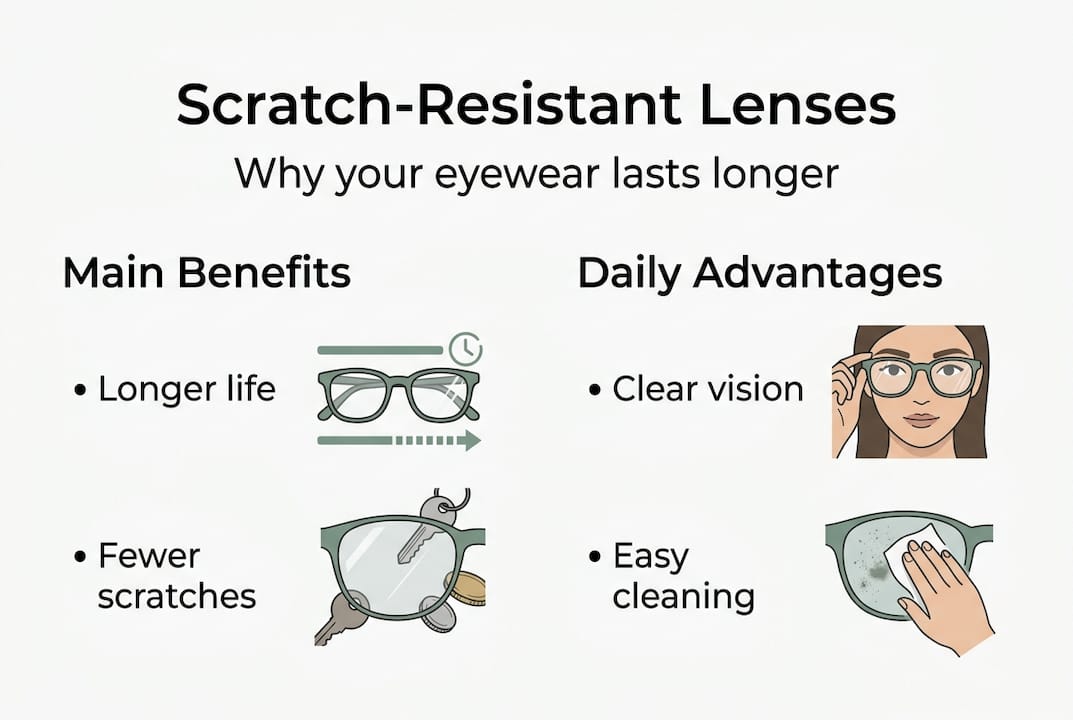
Once you understand why uncoated lenses fall short, the practical advantages of scratch-resistant coatings become very clear. The benefits are measurable, and they affect your wallet, your vision, and your daily comfort.
The most significant advantage is lifespan. Extended lens life of 2 to 4 years compared to just 12 to 18 months for uncoated lenses, plus cost savings of $300 to $500 over three years, makes coated lenses a genuinely smart financial decision. That is money staying in your pocket rather than going toward avoidable replacements.

| Feature | Coated lenses | Uncoated lenses |
|---|---|---|
| Average lifespan | 2 to 4 years | 12 to 18 months |
| Optical clarity over time | Maintained | Degrades with scratches |
| Replacement cost over 3 years | Lower | $300 to $500 more |
| Suitability for kids and sport | High | Low |
| Resistance to daily wear | Strong | Minimal |
For parents, this is particularly relevant. Kids are hard on everything, including their glasses. A coated lens that survives the school year without needing replacement is a practical win. For outdoor workers, tradies, and sports enthusiasts, the same logic applies. Understanding what makes glasses durable helps you make smarter choices from the start.
Visual clarity is the other major benefit. Scratches on uncoated lenses create micro-distortions that your brain works overtime to compensate for, leading to headaches and fatigue. Coated lenses maintain their optical quality far longer, which matters especially for clarity with ageing eyesight where precision vision is already a priority.
Scratch-resistant lenses are not just about avoiding damage. They are about maintaining the visual performance your prescription was designed to deliver.
Pro Tip: Use a microfibre cloth and a lens-safe spray cleaner every time you wipe your glasses. This simple habit removes abrasive particles before they can grind into the coating and dramatically extends its life.
What makes scratch-resistant coatings work?
Not all scratch-resistant coatings are created equal, and knowing the difference helps you choose the right lens for your needs. The technology behind these coatings has advanced significantly, and there are now several distinct options available.
Coatings are applied using different methods depending on the level of protection required. Siloxane hardcoats are applied via dip-coating or UV-cured processes and achieve a hardness of 500 to 800 HV (Vickers Hardness). Advanced Diamond-Like Carbon coatings, known as DLC, reach 2000 to 3000 HV and are applied through vacuum deposition or PECVD (Plasma-Enhanced Chemical Vapour Deposition). Multi-layer stacks combine several coatings to balance hardness, anti-reflection, and UV protection in one lens.
Here is a simple breakdown of the main coating types:
- Siloxane hardcoat: The most common and affordable option. Good for everyday use and standard Australian conditions. Applied as a liquid and cured to form a hard surface layer.
- Diamond-Like Carbon (DLC): Significantly harder and more durable. Excellent for active lifestyles, sports, and high-wear environments. Applied in a vacuum chamber for a very thin, very tough layer.
- Multi-layer stack: Combines scratch resistance with anti-reflective and UV-blocking properties. The best all-round option for Australians who want full optical performance.
When comparing eyeglass lens technology, hardness ratings give you a useful guide. A higher HV rating means greater resistance to surface abrasion, but it also tends to come with a higher price point. For most everyday users, a quality siloxane hardcoat delivers excellent results. For those with demanding lifestyles or high-value frames, DLC or multi-layer options are worth the extra investment.
Limitations and care: Setting realistic expectations
Here is something worth saying plainly: scratch-resistant does not mean scratch-proof. This distinction matters, and misunderstanding it leads to disappointment. No coating currently available will make a lens completely immune to damage.
Coatings wear over time, developing haze, delamination from heat or chemical exposure, and failure under sharp impacts or abrasive sand. Even DLC coatings, which are among the hardest available, can fail under the right conditions. Common situations where coatings struggle include:
- Direct contact with sharp objects like keys or tools
- Exposure to harsh cleaning chemicals or solvents
- Prolonged heat, such as leaving glasses on a car dashboard in the Australian summer
- Sand or grit wiped across the lens surface without rinsing first
- Repeated impacts or drops onto rough surfaces
It is also worth noting that glass lenses require no coating at all due to their inherent hardness. However, glass is heavier and more prone to shattering, which makes it a less practical choice for most people.
Practical care makes a measurable difference in how long your coating lasts. Follow these habits:
- Always rinse lenses with water before wiping to remove grit
- Store glasses in a hard case when not in use
- Avoid placing glasses face-down on any surface
- Never use paper towels, tissues, or clothing to clean lenses
- Keep glasses away from heat sources and chemical sprays
Pro Tip: If your lenses develop a hazy film that does not clean off, it may be early delamination of the coating. This is a sign it is time to consider replacement rather than continuing to strain your eyes through degraded optics.
For more on reading glasses care in Australia’s climate, practical guidance tailored to local conditions can help you get the most from your investment.
What most Australians miss about scratch-resistant lenses
There is a pattern we see repeatedly: someone invests in scratch-resistant lenses, treats them carelessly because they assume the coating will handle everything, and then feels let down when scratches appear. The coating is not a substitute for good habits. It is a buffer that extends the window of protection when you do the basics right.
Australia’s environment is genuinely demanding. The combination of UV intensity, airborne sand, and an outdoor-focused lifestyle means lenses here face more stress than in many other countries. That context makes ethical eyewear choices more important, not just in terms of materials but in terms of how you use and store what you buy.
The frame matters too. A durable lens in a flimsy frame that lets the lens flex or sit face-down is still going to get damaged. True longevity comes from treating your eyewear as a system, not just upgrading one component. Combining the right coating with a sturdy frame, a proper case, and sensible daily habits is what actually delivers lasting results. The coating is the start, not the whole answer.
Ready to upgrade? Explore eyewear and accessories
If this article has made you think differently about your current glasses, that is a good starting point. Protecting your lenses is not complicated, but it does require the right tools and the right eyewear from the beginning.

At Ministry of Sight, we stock a range of glasses accessories including cases, microfibre cloths, and chains that help you protect your investment every day. Browse our current eyewear deals for offers on scratch-resistant options, and explore our full range of stylish frames designed for durability and everyday Australian life. With free shipping across Australia and a satisfaction guarantee, upgrading your eyewear has never been more straightforward.
Frequently asked questions
Are scratch-resistant lenses completely scratch-proof?
No, scratch-resistant lenses are not scratch-proof. They offer meaningful extra protection but coatings can still fail under sharp impacts, abrasive sand, or harsh chemical exposure.
How long do scratch-resistant lenses typically last?
With proper care, scratch-resistant lenses typically last 2 to 4 years, which is significantly longer than the 12 to 18 months you can expect from uncoated lenses.
Is there a big cost difference between regular and scratch-resistant lenses?
Scratch-resistant lenses may cost a little more upfront, but they deliver savings of $300 to $500 over three years by reducing how often you need to replace your lenses.
Can I prevent scratches on my lenses besides the coating?
Absolutely. Storing your glasses in a hard case, rinsing before wiping, and using a microfibre cloth are simple habits that significantly extend lens life, even alongside a quality scratch-resistant coating.


